
Yggdrasil and the Nine Realms: The Structure of Norse Cosmology
Yggdrasil is the ash tree said to hold the Norse cosmos together — trunk, branches, and three roots binding nine worlds into one structure. The version most people know is a diagram from the 19th century. No Old Norse source ever wrote the nine worlds down as a list.
What follows is that structure as the Eddas actually give it, poem by poem, before the reconstruction got built on top of it.
What Is Yggdrasil?
Yggdrasil is an immense ash tree standing at the center of the Norse cosmos, described in the Poetic Edda — a collection of anonymous Old Norse poems compiled in Iceland in the 13th century, drawing on older oral tradition — and in the Prose Edda, written around 1220 by the Icelandic chieftain and scholar Snorri Sturluson. In both, the tree is evergreen, ash-leaved, and holy. The gods ride to it daily to hold their assembly.
What Does Yggdrasil Mean?
The name is a compound: Yggr, "the Terrible One," an alternate name for Odin, and drasill, "horse." Yggdrasil means, roughly, Odin's horse — a kenning for a gallows, since a hanged man is said to "ride" the gallows tree. The name points directly at the poem Hávamál, in which Odin hangs himself on the windswept tree for nine nights, pierced by his own spear, to win the runes. The tree is not scenery. It is the site of an ordeal.
Around this tree, the sources say, the nine worlds are arranged.
Were the Nine Realms Ever Actually Listed?
No — and the answer is short. The phrase "nine worlds" appears in only three places: Völuspá stanza 2, Vafþrúðnismál stanza 43, and Snorri's Gylfaginning. In each, the number nine is stated without the names attached to it. Völuspá's seeress recalls nine worlds from before the beginning of things; she doesn't name them. Gylfaginning ties its nine worlds specifically to the underworld ruled by Hel, not to the cosmos at large. No passage in either Edda lists nine named realms in one place.
What survives instead is a scatter of individual world-names, used across different poems for different stories, never gathered into one roster by the people who wrote them down. The wheel diagram — nine worlds arranged evenly around a central tree — comes from the 19th century. The Danish-Icelandic scholar Finnur Magnússon drew the first version in 1824; it was reprinted through the following decades and copied by Victorian illustrators after him. Six hundred years separate that diagram from the written sources, and closer to nine hundred from the oral tradition behind them.
The nine worlds are real to the cosmology. The circle is not — it's the shape scholarship gave to a set of poems that were never trying to be a map.
The Nine Worlds, As the Sources Describe Them
The list below is the standard modern grouping, assembled from world-names scattered across Völuspá, Grímnismál, and Gylfaginning.
Asgard — home of the Æsir, the ruling line of gods that includes Odin, Frigg, and Thor. Described by Snorri as a fortified, gold-rich stronghold, its wall left unfinished after the gods drove off the mason who built it.
Vanaheim — home of the Vanir, a second family of gods associated with fertility and prosperity, including Freyr and Freyja. Barely described in the surviving texts.
Alfheim — home of the light elves, the ljósálfar. Named in Grímnismál as a gift-realm given to the god Freyr.
Midgard — the world of humankind. See below.
Jotunheim — home of the jötnar, often translated "giants," a race in ongoing conflict and occasional intermarriage with the gods. Placed, in most reconstructions, beyond Midgard's edge.
Svartalfheim / Nidavellir — the dwarves' underground realm, called by two different names in different sources. See below.
Niflheim — a primordial realm of ice, mist, and cold, present before the ordered world existed. See below.
Muspelheim — a primordial realm of fire, Niflheim's opposite, home to the fire-jötunn Surtr.
Helheim — realm of the dishonorable dead, ruled by the being Hel, daughter of Loki.
What Realm Is Earth In Norse Mythology? Where Is Midgard on Yggdrasil?
Midgard — Old Norse Miðgarðr, "middle enclosure" — is the human world, placed centrally on the tree's trunk or at its base, walled off from the outer world by an encircling sea. In that sea lies Jörmungandr, the Midgard Serpent, a child of Loki grown so vast it rings the whole world and grips its own tail — read as much as a boundary marker as a monster, the edge of the known world given a body.
A rainbow bridge, Bifrost, connects Midgard to Asgard, guarded by the watchman-god Heimdall. It's the only crossing between worlds the sources name outright. How the other eight connect to it is left for illustrators to decide.
The Three Roots and Three Wells of Yggdrasil
Grímnismál gives Yggdrasil three roots: one reaching into Midgard, one into Jotunheim, and one into Hel. Völuspá names only one well beneath the tree, the Well of Urd, tended by the three Norns who shape fate. Snorri, writing later, expands this to three wells, one per root: Urd's well near Asgard; Mímir's well near Jotunheim, associated with wisdom and the eye Odin traded to drink from it; and Hvergelmir in Niflheim, the source-spring of the world's rivers and home to the dragon Níðhöggr, who gnaws at the root above it.
Snorri's three wells match his three roots too neatly to be an accident. He most likely built the third well onto Völuspá's one to complete the set. It's his version that survived into the popular imagination, not Völuspá's sparer one.
Is Valhalla One of the Nine Realms?
No. Valhalla — Old Norse Valhöll, "hall of the slain" — is Odin's hall within Asgard, not a separate world. It houses one half of those who die in battle, chosen by the Valkyries; the Prose Edda sends the other half to the field Fólkvangr, overseen by the goddess Freyja. Both halls sit inside Asgard's boundaries. Neither appears as an independent entry in any list of the nine worlds.
Is Helheim the Same as Niflheim?
Usually treated as distinct, though the sources themselves blur the line. Niflheim is one of two primordial realms present before creation — ice, frost, and mist, paired with fiery Muspelheim across the void of Ginnungagap. Helheim is the realm of the dishonorable dead, ruled by Hel. In Gylfaginning, Snorri writes that Hel was cast into Niflheim and given authority over nine worlds of her own within it — a line that overlaps the two realms rather than keeping them apart. A third term, Niflhel, "the dark part of Hel," appears elsewhere and may be exactly this overlap: a lower district of Helheim bordering, or absorbed into, Niflheim proper.
The confusion is not a modern misreading. It's already present in the 13th-century source.
Is Helheim one of the nine realms? Under the standard reconstruction, yes — counted separately from Niflheim, even where the texts themselves waver on the line between them.
Svartalfheim or Nidavellir?
Nidavellir — "the low fields" or "dark fields" — is the older name, appearing in Völuspá, where it's a golden hall in the north belonging to the dwarf-kin of Sindri. Svartalfheim — "home of the black elves" — appears nowhere in the Poetic Edda and is used only by Snorri, who treats the dwarves and "dark elves" as effectively interchangeable. Whether he was recording a second name already in use, or coining one to round out his own system, the sources don't say. Most modern treatments merge Svartalfheim and Nidavellir into one realm under two names — a reasonable reading, though not one the texts state outright.
Is There an Original Yggdrasil Map?
No manuscript from the Viking Age or medieval Iceland shows the nine worlds mapped out spatially. What exists in the original sources is individual place-names, mentioned in passing, rooted to a tree. The earliest known attempt to lay the cosmology out as a diagram is Finnur Magnússon's, drawn in 1824 and reprinted through the following decades. Every "Viking nine realms map" now in circulation descends from that one 19th-century image, not from anything Viking.
No manuscript from the Viking Age or medieval Iceland shows the nine worlds mapped out spatially. What exists in the original sources is individual place-names, mentioned in passing, rooted to a tree. The earliest known attempt to lay the cosmology out as a diagram is Finnur Magnússon's, drawn in 1824 and reprinted through the following decades. Every "Viking nine realms map" now in circulation descends from that one 19th-century image, not from anything Viking.
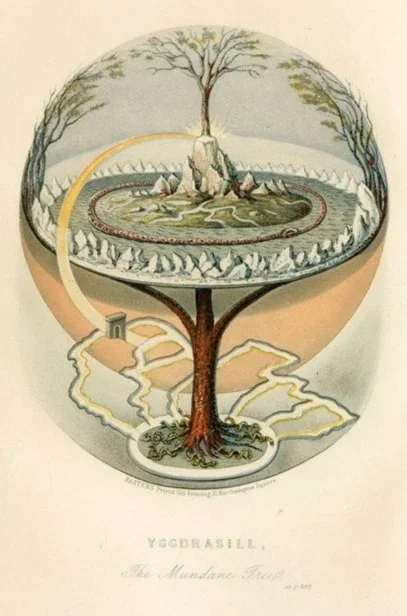
Yggdrasil, the Mundane Tree.
Copied after Finnur Magnússon's 1824 diagram, published in Northern Antiquities (London: Henry G. Bohn, 1859). Boston Public Library, Norman B. Leventhal Map & Education Center Collection. No known copyright restrictions.
The Nine Worlds, Assembled
The tree, the roots, and the number nine are the parts of Norse cosmology the sources give directly. The labeled circle most people picture was built afterward, in the 19th century, from names the poems never arranged themselves.
Etherfolk built a version anyway: a framed canvas laying out the nine worlds along Yggdrasil's structure, available labeled or plain.
In the archive at etherfolk.com: